 Add to Chrome
 Add to Firefox
 Add to Edge
SAHG: Sector-Anisotropic Hyperbolic Graph Model for Social Bot Detection
May 28, 2026
LLM-driven social bots can generate fluent, human-like text, reducing the discriminative advantage of content-based detection alone. However, coordinated campaigns still leave relational patterns -- interactions, behavioral similarity, shared neighborhoods, community positions, and coordinated activity -- that graph-based methods can exploit. Existing graph detectors face two challenges when exploiting such evidence. First, Euclidean GNNs distort hierarchical and scale-free social graphs; while hyperbolic geometry addresses this volume-growth mismatch, fixed-curvature models still assign uniform geometric resolution to structural directions with different densities and separation needs. Second, relational evidence is not always reliable: sophisticated bots forge heterophilic connections with genuine users, causing neighborhood aggregation to mix bot and human signals and dilute account-level evidence. We propose \textsc{SAHG} (Sector-Anisotropic Hyperbolic Graph), addressing both challenges. \textsc{SAHG} learns a direction-dependent curvature field $γ(u)$ that adapts geometric resolution across structural directions, and uses sector prototypes to convert angular concentration and alignment into classifier-readable features. To prevent contaminated aggregation from overwhelming account-level evidence, \textsc{SAHG} encodes per-account features and graph-neighborhood representations in two independent SAH channels, fusing them only at the classifier. Experiments on Fox8-23, BotSim-24, and MGTAB show that \textsc{SAHG} achieves the highest accuracy and F1 on all three benchmarks, outperforming feature-based, graph-based, LLM-based, and isotropic hyperbolic baselines. Ablation and geometric analyses confirm the effectiveness of the anisotropic geometry and dual-channel design.

FinHarness: An Inline Lifecycle Safety Harness for Finance LLM Agents
May 26, 2026Finance LLM agents must simultaneously block prompt-induced unauthorized actions and approve legitimate multi-step business workflows. However, boundary filters often miss irreversible mid-trajectory tool calls, while post-hoc LLM judges perform auditing only after termination -- too late for intervention and at a computational cost that scales linearly with trace length. We present FinHarness, an inline safety harness that wraps a finance agent end-to-end with three components: a Query Monitor that fuses single-turn intent with cross-turn drift, a Tool Monitor that evaluates each prospective tool call, and a Cascade module that integrates per-step risk and adaptively routes verification between a lightweight and an advanced-tier LLM judge. Fired risk factors are re-injected into the agent input as ex-ante evidence, enabling the agent to refuse, re-plan, or approve on its own. On FinVault, routed FinHarness cuts ASR from 38.3% to 15.0% while largely preserving benign approval ($41.1\% \to 39.3\%$), and uses $4.7\times$ fewer advanced-judge calls than an always-advanced ablation.
ExTax: Explainable Disinformation Detection via Persuasion, Emotion, and Narrative Role Taxonomies
May 26, 2026The democratization of LLMs has accelerated the generation and circulation of highly fluent disinformation, making traditional syntax-semantic verification increasingly insufficient. Such deception rarely relies solely on surface-level falsity; instead, it often combines persuasive rhetoric, emotional manipulation, and narrative role construction to influence readers' interpretations through multiple cognitive pathways. However, existing detectors typically emphasize isolated signals -- such as syntax, external knowledge, persuasion, or affective cues -- and therefore struggle to capture the multi-faceted manipulative intents underlying disinformation or provide human-auditable explanations. To address this gap, we present \textbf{ExTax}, a taxonomy-aligned framework for explainable disinformation detection. ExTax unifies persuasive rhetoric, emotional manipulation, and narrative roles into a 17-dimensional taxonomic space, covering 6 persuasive-rhetoric strategies, 5 emotional-manipulation methods, and 6 narrative-role categories. It elicits attributes from multiple frontier LLMs, reconciles their disagreements through Entropy-driven Dynamic Label Smoothing, and fuses the resulting taxonomic representations with contextual encodings via Heterogeneous Multi-Head Attention, grounding each prediction in an interpretable manipulation profile. Across five cross-domain and cross-genre benchmarks, ExTax achieves an overall Macro $F_1$ of $0.8456$, outperforming state-of-the-art deep learning and LLM-based baselines. It also remains robust under severe genre imbalance, where the strongest deep baseline degrades from $0.9454$ to $0.6194$.
SafeHarness: Lifecycle-Integrated Security Architecture for LLM-based Agent Deployment
Apr 15, 2026The performance of large language model (LLM) agents depends critically on the execution harness, the system layer that orchestrates tool use, context management, and state persistence. Yet this same architectural centrality makes the harness a high-value attack surface: a single compromise at the harness level can cascade through the entire execution pipeline. We observe that existing security approaches suffer from structural mismatch, leaving them blind to harness-internal state and unable to coordinate across the different phases of agent operation. In this paper, we introduce \safeharness{}, a security architecture in which four proposed defense layers are woven directly into the agent lifecycle to address above significant limitations: adversarial context filtering at input processing, tiered causal verification at decision making, privilege-separated tool control at action execution, and safe rollback with adaptive degradation at state update. The proposed cross-layer mechanisms tie these layers together, escalating verification rigor, triggering rollbacks, and tightening tool privileges whenever sustained anomalies are detected. We evaluate \safeharness{} on benchmark datasets across diverse harness configurations, comparing against four security baselines under five attack scenarios spanning six threat categories. Compared to the unprotected baseline, \safeharness{} achieves an average reduction of approximately 38\% in UBR and 42\% in ASR, substantially lowering both the unsafe behavior rate and the attack success rate while preserving core task utility.
FedRio: Personalized Federated Social Bot Detection via Cooperative Reinforced Contrastive Adversarial Distillation
Apr 12, 2026Social bot detection is critical to the stability and security of online social platforms. However, current state-of-the-art bot detection models are largely developed in isolation, overlooking the benefits of leveraging shared detection patterns across platforms to improve performance and promptly identify emerging bot variants. The heterogeneity of data distributions and model architectures further complicates the design of an effective cross-platform and cross-model detection framework. To address these challenges, we propose FedRio (Personalized Federated Social Bot Detection with Cooperative Reinforced Contrastive Adversarial Distillation framework. We first introduce an adaptive message-passing module as the graph neural network backbone for each client. To facilitate efficient knowledge sharing of global data distributions, we design a federated knowledge extraction mechanism based on generative adversarial networks. Additionally, we employ a multi-stage adversarial contrastive learning strategy to enforce feature space consistency among clients and reduce divergence between local and global models. Finally, we adopt adaptive server-side parameter aggregation and reinforcement learning-based client-side parameter control to better accommodate data heterogeneity in heterogeneous federated settings. Extensive experiments on two real-world social bot detection benchmarks demonstrate that FedRio consistently outperforms state-of-the-art federated learning baselines in detection accuracy, communication efficiency, and feature space consistency, while remaining competitive with published centralized results under substantially stronger privacy constraints.
Mitigating Homophily Disparity in Graph Anomaly Detection: A Scalable and Adaptive Approach
Mar 09, 2026Graph anomaly detection (GAD) aims to identify nodes that deviate from normal patterns in structure or features. While recent GNN-based approaches have advanced this task, they struggle with two major challenges: 1) homophily disparity, where nodes exhibit varying homophily at both class and node levels; and 2) limited scalability, as many methods rely on costly whole-graph operations. To address them, we propose SAGAD, a Scalable and Adaptive framework for GAD. SAGAD precomputes multi-hop embeddings and applies reparameterized Chebyshev filters to extract low- and high-frequency information, enabling efficient training and capturing both homophilic and heterophilic patterns. To mitigate node-level homophily disparity, we introduce an Anomaly Context-Aware Adaptive Fusion, which adaptively fuses low- and high-pass embeddings using fusion coefficients conditioned on Rayleigh Quotient-guided anomalous subgraph structures for each node. To alleviate class-level disparity, we design a Frequency Preference Guidance Loss, which encourages anomalies to preserve more high-frequency information than normal nodes. SAGAD supports mini-batch training, achieves linear time and space complexity, and drastically reduces memory usage on large-scale graphs. Theoretically, SAGAD ensures asymptotic linear separability between normal and abnormal nodes under mild conditions. Extensive experiments on 10 benchmarks confirm SAGAD's superior accuracy and scalability over state-of-the-art methods.
Reversible Upper Confidence Bound Algorithm to Generate Diverse Optimized Candidates
Dec 30, 2021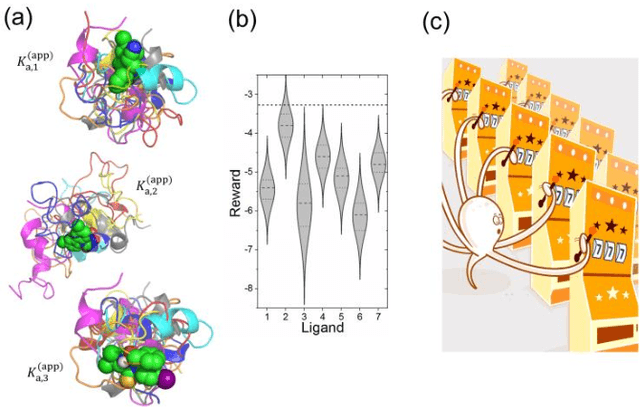
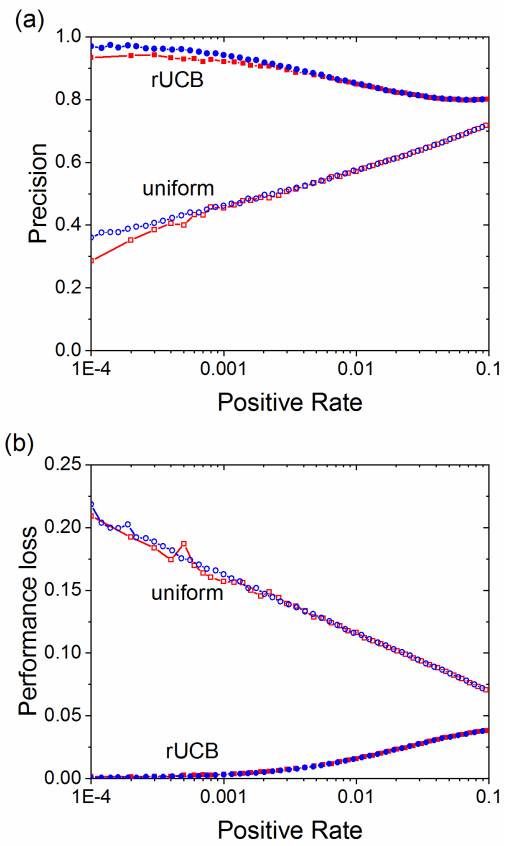
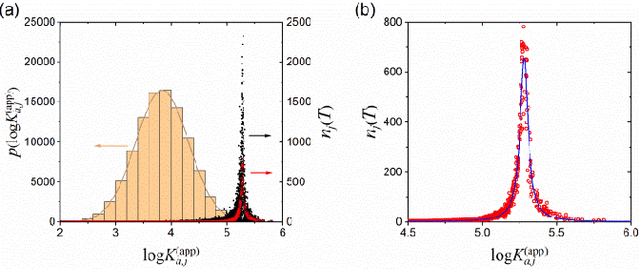
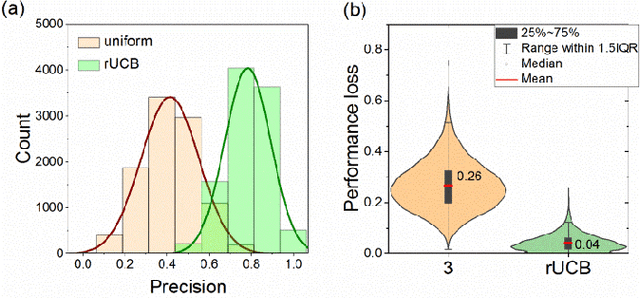
Most algorithms for the multi-armed bandit problem in reinforcement learning aimed to maximize the expected reward, which are thus useful in searching the optimized candidate with the highest reward (function value) for diverse applications (e.g., AlphaGo). However, in some typical application scenaios such as drug discovery, the aim is to search a diverse set of candidates with high reward. Here we propose a reversible upper confidence bound (rUCB) algorithm for such a purpose, and demonstrate its application in virtual screening upon intrinsically disordered proteins (IDPs). It is shown that rUCB greatly reduces the query times while achieving both high accuracy and low performance loss.The rUCB may have potential application in multipoint optimization and other reinforcement-learning cases.
* 10 pages, 10 figures